EmailSnap
Forward any email to review@emailsnap.app, and LLM agents send back a clear summary, action items and properly named attachments.

Why
By September 2024, image-capable LLMs could help with a task that text summarizers missed: reading the scanned documents attached to an email. I wanted to connect that ability to the routine work happening in inboxes every day.
A long thread arrives with a PDF called something like scan_001.pdf. Before doing anything useful, someone has to read the conversation, open every attachment, work out what matters, rename the files, and pass them on. For a clinic receptionist, bank clerk or service business, that preparation is part of the job, repeated over and over.
EmailSnap explored how much of that preparation a chain of LLM agents could do. The interface was the part I liked most: forward an email, get an email back. The automation could fit into an existing workflow without asking people to move their work into another app.
How
During the trial, approved senders forwarded messages to review@emailsnap.app. The service then worked through four steps:
- Untangle the thread: turn the raw email into readable text, including forwarded messages.
- Read the attachments: process images and PDF pages alongside the message.
- Review each file: extract highlights and action items, suggest a recipient, and give the attachment a meaningful name.
- Reply with the whole picture: combine the thread and document reviews into one email, with the renamed files attached.
The result included a [Priority] Subject, highlights, a summary and suggested next actions. You could understand what had arrived before digging through the original material.
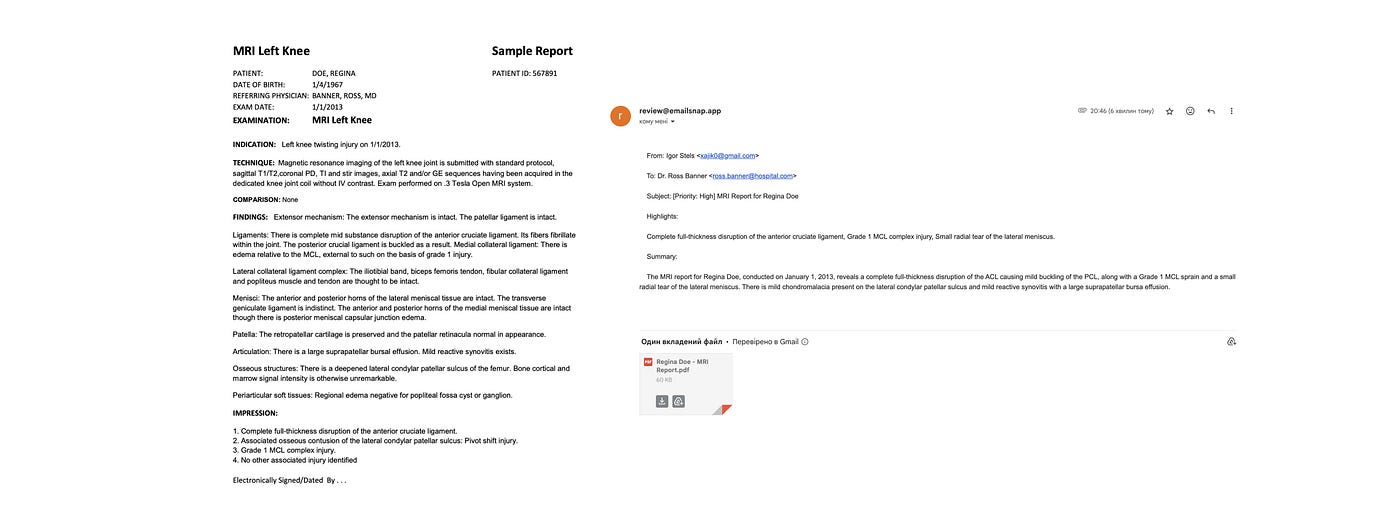
In the published demo, a sample MRI report became a review with extracted document details and an attachment named for its content. It showed why reading the files mattered as much as summarizing the email itself.
I published EmailSnap in September 2024. The hosted experiment is now archived, and the code remains open source: an example of putting multi-step AI processing behind an interface people already know how to use.